This article was originally published on the website of The Norwegian Association of Children and Young People’s Book Authors (NBU) here.
This spring, Xueting Yang travelled to South Africa as part of a collaboration between NBU and Pen Afrikaans. Together with five writers from around the world, she spent three weeks on a writing residency in KwaNojoli. Through the encounter with five plants, we get to join the journey:
1
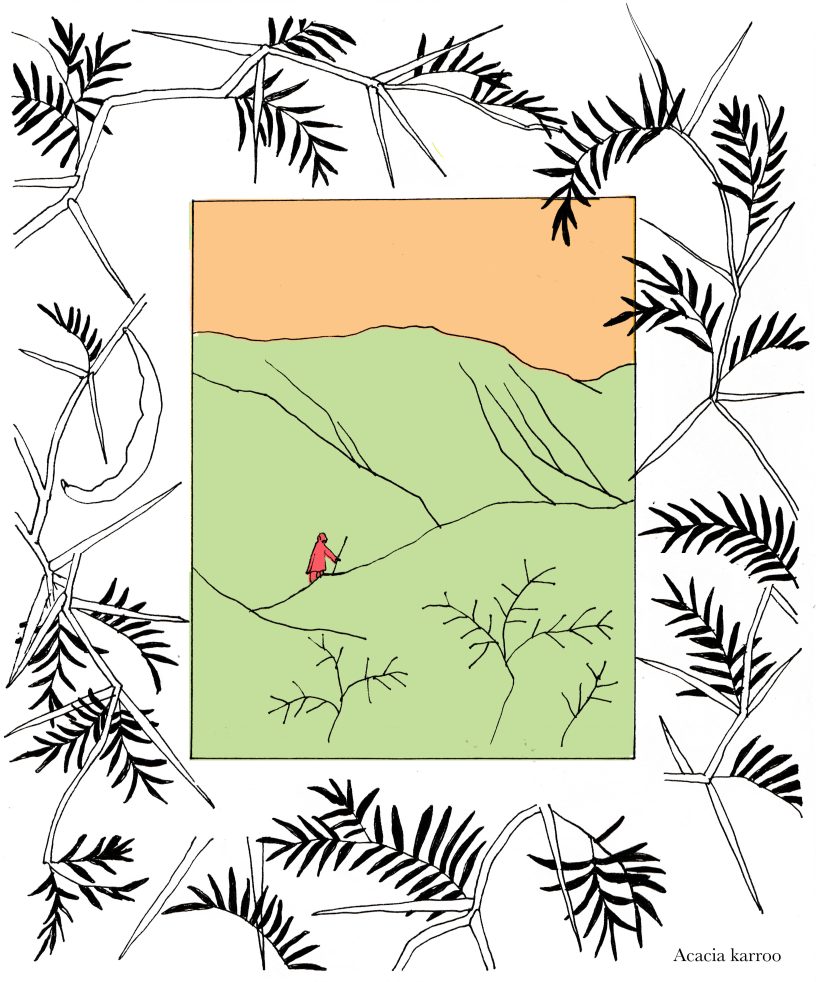
When I first landed in South Africa, this plant immediately caught my eye. Its long stems were covered in massive thorns—pure white, long, hard, and incredibly sharp, as if ready to pierce anything that dared come close. This was the Karoo Acacia. Back then, I too felt deeply uneasy about everything unfamiliar in this country. I didn’t know which streets were safe, whether I could walk out alone after dusk, why shop items were locked behind iron bars, or why even the churches were completely surrounded by high walls.
What I didn’t know then was that none of the dangers I feared would actually happen. Slowly, this land began to show me a balance among all living things that I had never seen before. I came to understand that the sharp thorns were only meant for self-protection, not out of aggression. It was precisely because of these thorns that the tender leaves and bark of the Karoo Acacia were not quickly eaten away by the massive herbivores migrating across the land. They grew slowly in the dry soil. Year after year, they opened into golden flowers and grew long seed pods. For millions of years, they were always existing together with everything above and beneath the soil. Whenever the ancient people saw vast valleys of Karoo Acacia, they knew that they would find water deep under the dry ground; they knew they could live here. Beneath these thorny trees, they would stand together with their ancestors to hold celebrations for their newborn children.
2
«Get out of my land!»
«Whose land is this?»
There were six writers and three staff members living together at the Paulet House writing residency. We belonged to different races, and most came from different parts of South Africa. The issue of race, like the elephant in the room, was impossible to avoid. The political discussions around the dinner table were the most painful debates I had ever witnessed. It was not just a clash of political ideas; people were telling stories of the pain suffered by every person they knew, the pain happening right now on the streets, the pain endured by all those who died one after another over five hundred years of colonisation, and the pain that their children would continue to bear tomorrow morning. People were using their only flesh to carry such heavy suffering.
Sometimes, I had to walk out onto the streets just to digest the pain brought on by watching theirs.
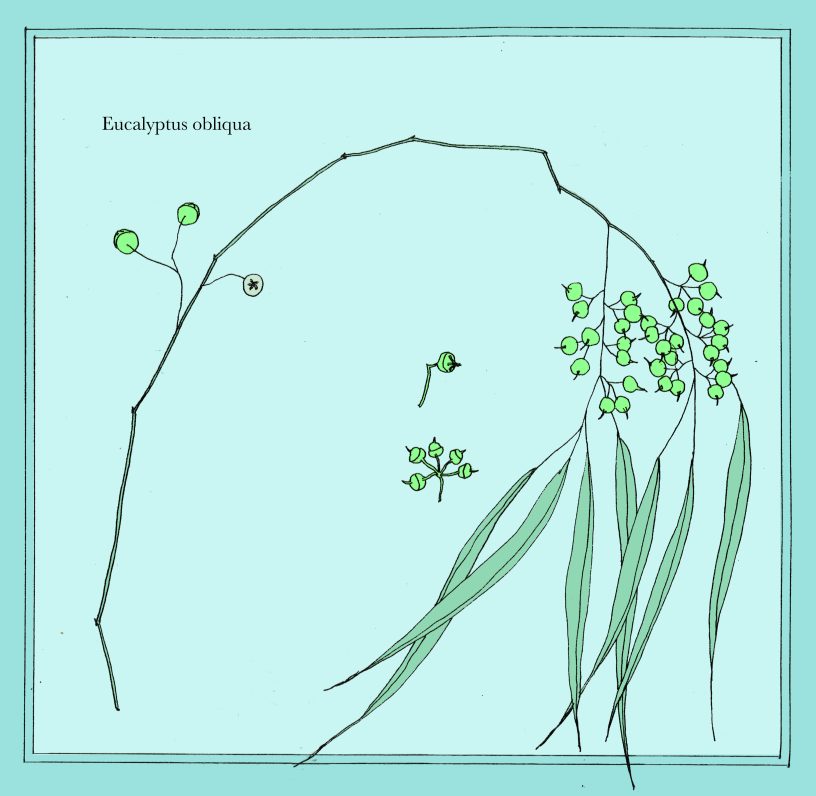
On both sides of the village roads grew an incredibly tall kind of tree. Their trunks were thick and straight, with smooth grey bark peeling off and hanging down to the ground. Their leaves were thin, giving off a strong, sharp fragrance. These were the eucalyptus trees.
About 250 years ago, during the time of colonial expansion, colonisers brought these fast-growing trees from Australia—which had a similar climate—and planted them here. They wanted to build railways quickly to move gold, diamonds, and other minerals stolen from the African interior. For centuries, the eucalyptus trees followed their own rhythm, growing rapidly and using their huge, powerful roots to suck up all the water deep in the soil. But the gold mines have long been empty, the railways often stop working, and the tracks along the way have long been rusty. Today, the useless eucalyptus is marked as a harmful alien species, and the local community has to cut it down to save the underground water. They call this «working for water.»
180 million years ago, the ancient continent of Gondwana began to move slowly, breaking into seven new plates: Africa, Australia, Antarctica, South America, Zealandia, Madagascar, and India. South Africa, as the geographic core of that ancient land, naturally kept the richest and most diverse plant and animal life in the world today. The ancestors of the eucalyptus, the flowering plants, floated to the far ends of the ocean with the moving Australian plate. There they grew and evolved, only to be brought back to South Africa for two hundred years. Such a short flash of time—not yet long enough to bring any peace.
3
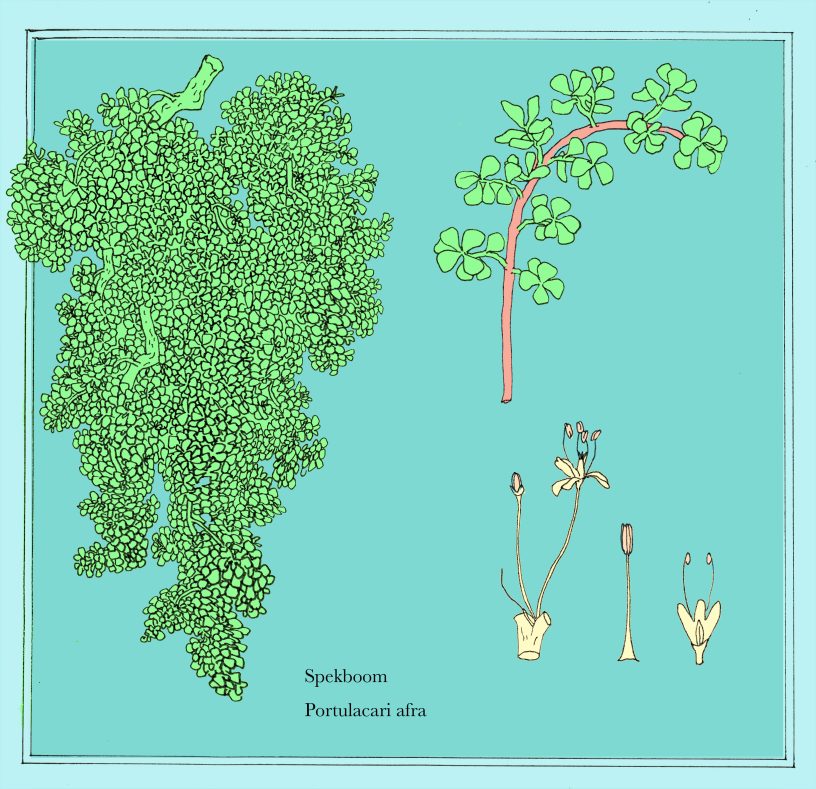
The region where Paulet House sits is called the Great Karoo. It lies deep in the heart of South Africa, far from the coast. It rarely rains here, and the endless mountains and plains show a dry, dusty green, vast and heavy with the scent of yellow earth. You have to drive for hours just to pass another small town with only two or three streets. The children of the town flash past the car window, and then the vehicle drives back out into the endless wilderness. Jan, a South African writer who had lived in the Karoo for decades. Once, while we were walking together, he stopped, pointed to a bush by the roadside, and told me: «This is Spekboom. If you are walking in the Karoo and have no water, eat this.» He rubbed a leaf between his fingers, squeezing out bright green juice. Spekboom is a succulent plant commonly seen in South Africa, very easy to recognise with its bright red stems and small, bright green leaves. It absorbs huge amounts of carbon dioxide and is rich in vitamin C. The leaves have a bright, sour taste like sorrel, very crisp and refreshing.
From Jan’s face, I could feel that what he was sharing was one of the most important survival lessons an elder could pass down to the next generation in this desert world. I accepted his seriousness, though I never thought I would actually need to eat Spekboom to quench my thirst on a long walk.
Little did I know that such a chance would come so soon. After the residency ended, I continued my journey alone to Addo Elephant National Park. Spekboom is also called Elephant Bush. Elephants use their flexible trunks to slide the small green leaves right off the stems to eat. They love the sour taste of the leaves. An adult elephant spends 16 hours a day eating and can consume two hundred kilograms of plants. I stayed in a well-equipped camp inside the park. Like all tourist projects organised by humans, every sip of water here costs money. Because I didn’t have a car, I couldn’t leave the camp to buy groceries and could only live on the expensive food at the restaurant.
At dusk, I sat on the steps outside my door, watching the light slowly fade into darkness as the sounds of insects drifted in from near and far. The Southern Cross shone in the night sky of the Southern Hemisphere; just like the Big Dipper in the Northern Hemisphere, it stayed constant, guiding the people on Earth. I ate the Spekboom leaves bite by bite, while the elephants hidden in the dark chewed along with me.
4
When I first met the little boy Nillen, he had just picked up a brown nut from the road, peeled it, and ate it. Nillen was twelve years old. When he told me this, I was surprised—he was so small that I thought he was only seven or eight. «This is good to eat. » he told me. I looked around, but there were no trees with fruit nearby, so I asked if he could take me to see the nut tree. The next day, I went out for a walk after lunch and saw Nillen waiting for me on the road right outside Paulet House. He had brought a long reed pole and a piece of bent wire.
At this moment, Norway in the Arctic was entering spring, and the grass was fresh and green. But the plants in the Southern Hemisphere had already finished another rich summer and were dropping their fruits one by one.
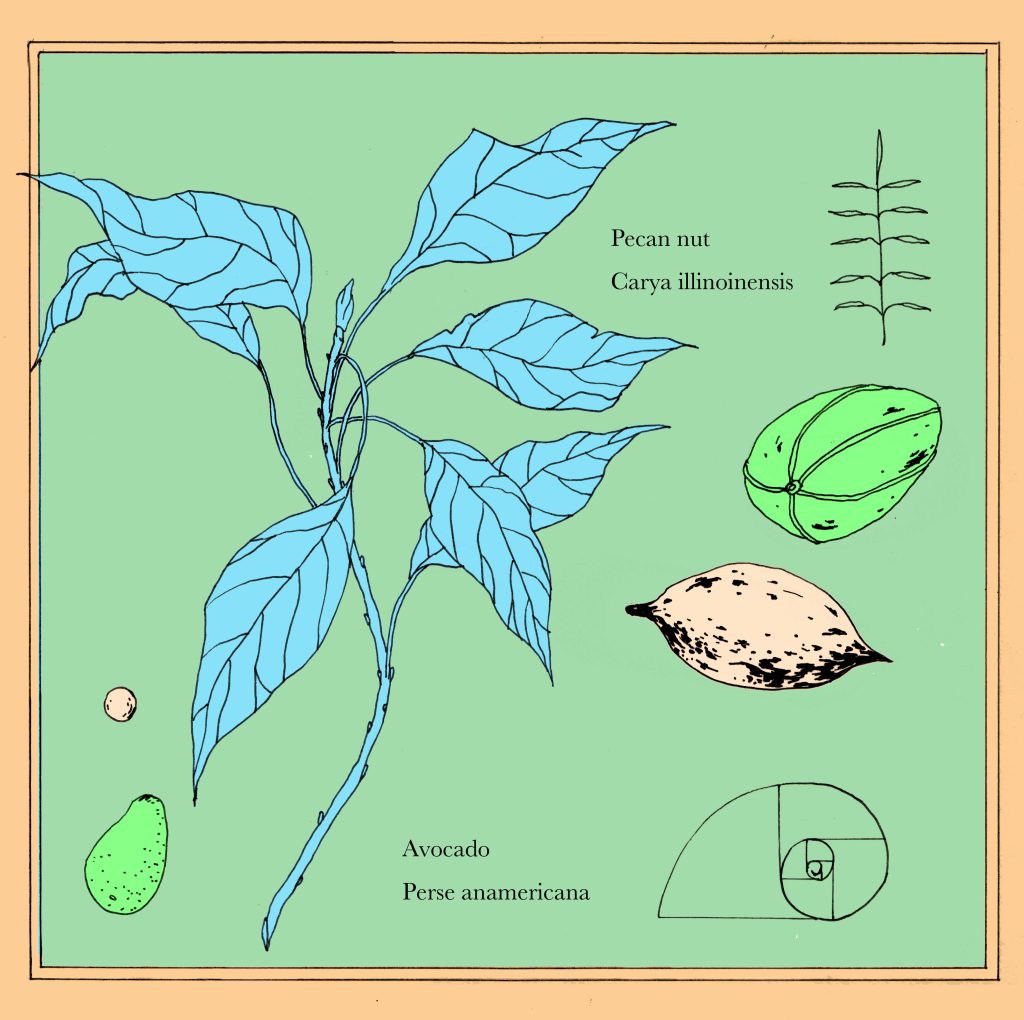
Nillen led me into someone’s backyard. He said the owner was very nice and told him he could come to pick them. The tree was tall and its shade was thick. The leaves were slowly turning yellow, and their shape and smell reminded me very much of the walnut trees we have in Norway. Nillen taught me how to hook the green fruits whose outer skin had already cracked open. The uncracked ones were not ripe yet, so we shouldn’t pick them—»They aren’t good to eat.» I peeled away the thick, bitter green skin, cracked open the crisp brown shell, and suddenly recognised the shape of the nut inside. This was a pecan nut! An expensive nut I often saw on store shelves on the other side of the world.
In just a few moves, Nillen climbed up another tall tree. His thin body swung among the bright green leaves as he skillfully picked large fruits from the branches. «This is ukwatapheya,» he said, «it’s good to eat too.» The fruit hit the ground with a loud thud. I picked it up and looked—it was a rock-hard, green avocado! I looked up at the avocado tree, its shape and leaves completely strange to me, yet so tall and beautiful. My heart filled with deep emotion; we had only just met, yet I had already eaten so many of your children and grandchildren.
Just then, a powerful shout suddenly burst from the house nearby: «Fucking get out! Stealing my things! Get out of my land! I’m calling the police right now! Get out!» The shouting didn’t stop. I quickly grabbed the pole, Nillen bent down to fill his pockets, and we ran away together. This was how Nillen solved the problems he couldn’t solve otherwise. I did the exact same thing when I was a child—by telling myself a little lie, the world instantly became easier. The pants, heavy with nuts, hung loosely on Nillen’s two thin black legs, and he kept pulling them up as he walked.
Nillen, I asked the tree, and I asked the fruit. They both said you could pick them.
The pigs and the monkeys can pick them too—so come along!
Every hungry animal can come to the tree in autumn.
The ripe fruits open, and the unripe ones, just like you, will keep growing.
5
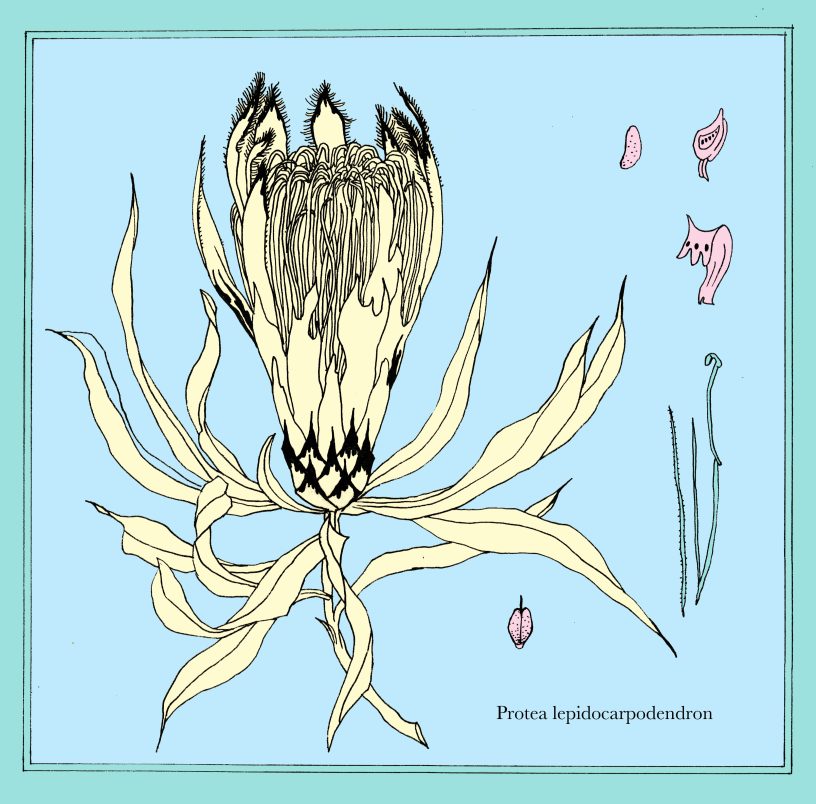
At the end of the trip, I arrived in Cape Town, a miraculously beautiful city sitting between the rocks and the sea at the southernmost tip of Africa. Walking up the mountain path of Table Mountain, the view changed as the altitude rose. The city slowly revealed its full face, and the tall, thick trees began to thin out, turning into bushes that came up to a person’s height. Suddenly, I saw a field of incredibly bright flowers blooming on the hillside. This was South Africa’s national flower, the Protea.
The Protea has lived on for over a hundred million years, tracing its line all the way back to when dinosaurs walked these mountains. It has a very unique survival skill—it can live through wildfires and return with new life, making it one of the oldest plant families on Earth. During my previous hikes in the Karoo, I had secretly hoped to find this high-mountain plant, but I had never been able to see it with my own eyes. Now, the sea breeze brought damp air, and red, white, pink, and golden Proteas bloomed right along the edge of the steep cliffs. The overall shape of the Protea plant was very close to a mountain rhododendron, and its leaves, like many African plants, were smooth and thick like thin leather—strong enough to fight the harsh weather and the animals trying to eat them. Its flowers were massive, shaped like a king’s wine chalice, with petals pointing toward the sky like a cluster of swords.
I marvelled at their fierce beauty and climbed onto a higher rock, wanting a closer look at these giant flowers shining like gems. As I reached out and pulled a branch lower, the thick, heavy nectar gathered inside the flower dripped right into my mouth. In that split second, I understood why South Africans, no matter their race, use the Protea to celebrate weddings.
We together, leave the village in the early morning, walking the long mountain paths while the sun breaks through the thin mist over the distant sea.
We together, walk along, sometimes in silence, sometimes singing, mimicking the calls of birds, climbing up along the stream as the clouds gather over the mountain ridge and the rocky layers appear and disappear.
We together, try to find a flower for the newlyweds—a flower that is sharp and enduring, stubborn and fierce, yet carrying an unmatched sweetness inside.
This flower stands for happiness, happiness on our land.
Illustration by Xueting Yang


One thought on “Lessons from the land – Paulet House writer from Norway reflects on residency”
Wow, what seems obvious to us born and bred in the Karoo (kwaNojoli), to a writer’s mind can be transformed into an enriching and long lasting article. A great read.