


Photos by Brick Mbekwa
Lost in Translation? Or documenting our stories as art.
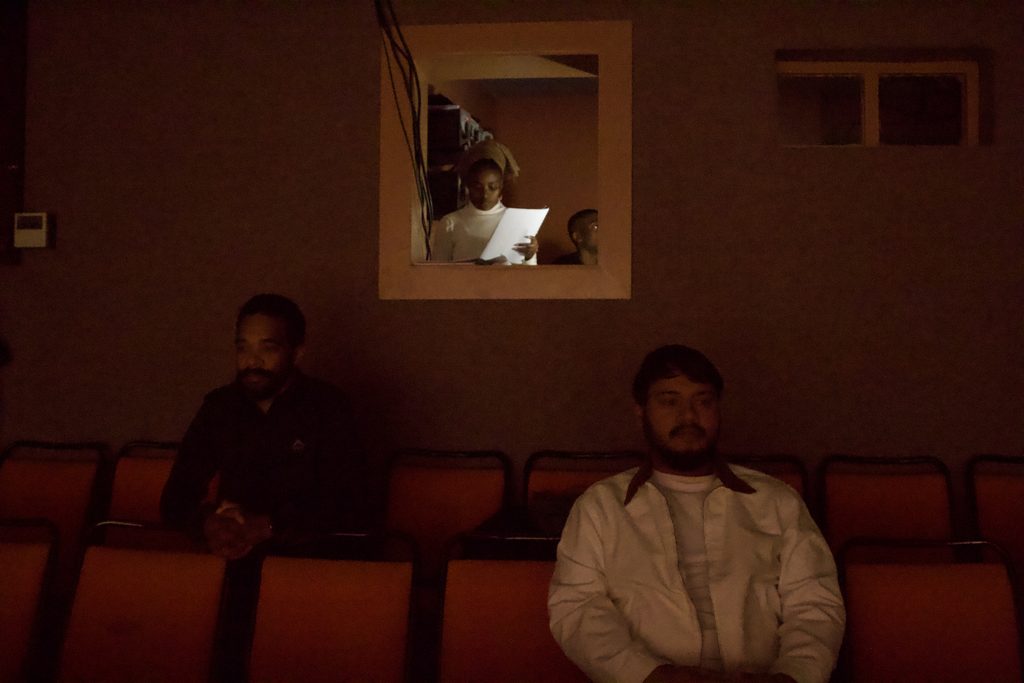
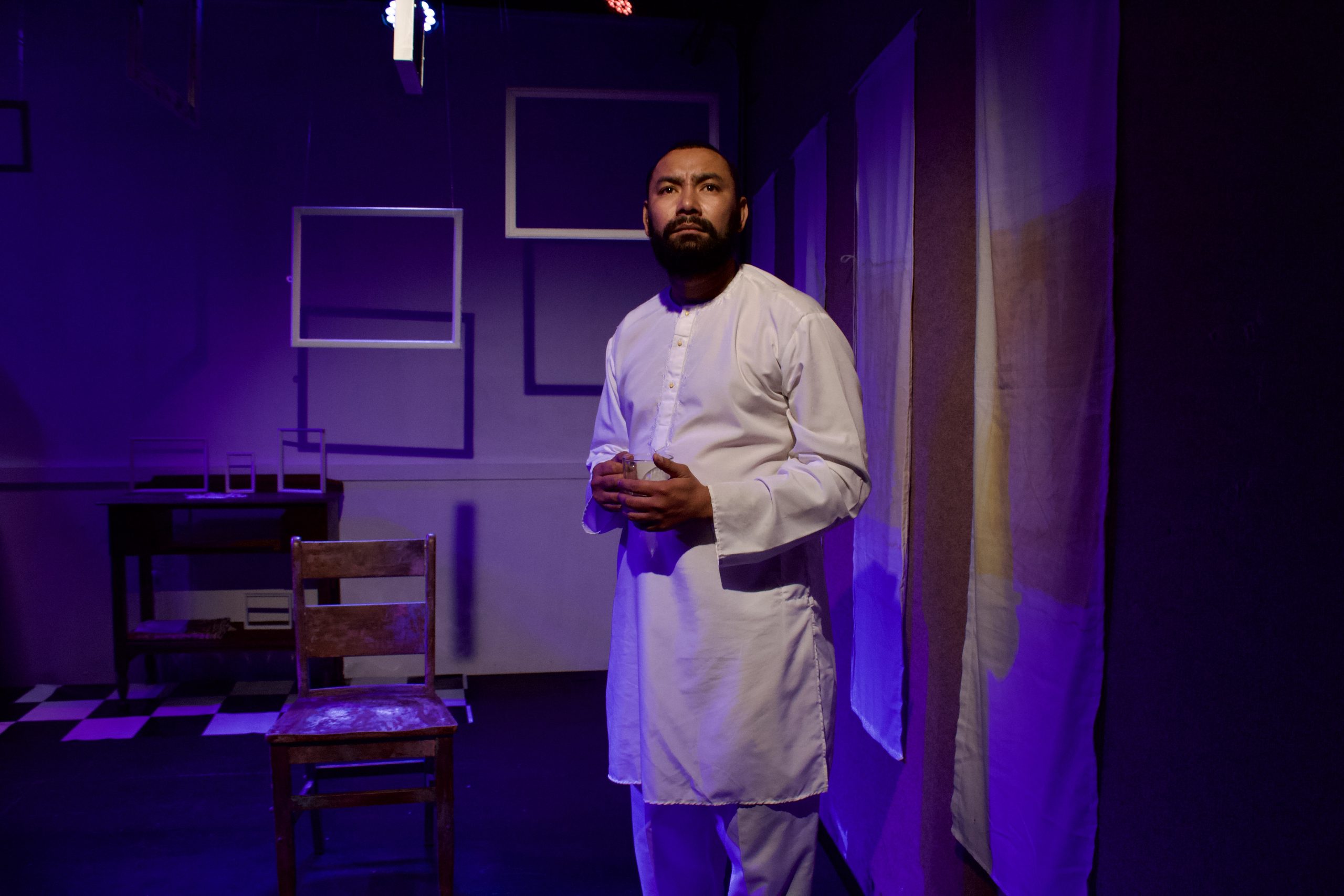
There’s the immersive world that started when we walked into the Baxter Masambe Theatre: the myang stokkies, art representing both Islam and Cape Malay culture on the wall by artist Ni-shaat Bardien Dreyer, and ghadat playing in the foyer. After we scanned our tickets and officially entered (the lights dimming and settling on the character Luqmaan, who is on the stage in all white, with a cup in his hands), an actor starts his monologue. I had goosebumps.
My chest felt warm as I listened to him.
Because he sounded like my daddy, my mommy, my ouma, my family, my friends.
He sounded familiar.
And my whole heart reacted – this was my initial feeling when I went to watch Brasse, Tot Laat Toe at the Baxter Theatre on a weeknight, which, for me, is already a feat, but knowing this play was written in Kaaps, drew me to go out after five on a Friday night.
I am familiar with Zubayr Charles’ writing after having read his debut novel Haram, and I knew that I was in for an emotional experience with his fifth play. But if I had to write down all my thoughts immediately after, it would have been an incoherent piece of writing, because after watching this play, I was a complete emotional mess.
I had to sleep on it to dissect why.
Let there be no confusion, the play is damn good.
The narrative follows Luqmaan, who receives an unexpected visit from his former friend, Junaid. It is the forty-nights memorial for his late wife, Ayesha, and Luqmaan and Junaid have not seen each other in more than six years. And as Junaid returns under unexpected circumstances, both men are forced to confront uncomfortable truths about friendship, betrayal, and the lives they have built apart.
With a premise that teases emotion, the writing makes what the actors say feel so real. The play rests on Abdullatief Davids and Anzio September not only embodying their lines, performing them as though they are their own words, but also bringing this two-hander to life.
Despite the intentionality of his minimalist set design, which clearly shows us where we are (the time jumps between Luqmaan’s home and the school detention scenes), director Carlo Daniels is creatively flamboyant when it comes to physical theatre. The physical theatre was an unexpected aspect of the play. The characters paced and looked around, adding to the urgency of being in detention and not wanting to be caught doing something that would lead to more detentions on a Saturday.
September brings Junaid to life and moves the character in a corporeal way. When we find out that Junaid is ill, and especially when he was dying, September made me feel the pain in his body within mine. Luqmaan is steady, an anchor for the audience throughout the performance. He performs salaah (prayer) on the stage, and I found myself tearing up. This Muslim character with a beard, wearing a salaah thobe (attire for prayer), was like the Muslim men I have been around my whole life, subverting the image I’ve encountered on screens. It is through these intentional, subtle nuances that the story moved me most: small, familiar details that accumulated into something deeply affecting.
And despite the heaviness of loss in the play, when Luqmaan starts dancing to a “yardt nommer”, it gives the audience a little break from the emotional depth of the story, a chance to giggle at the silliness of his movements, to regroup. For me, it also showed how Junaid felt dismissed when he would bring up his feelings with his friend Luqmaan.
I have read that perhaps Junaid was a ghost and this was how Luqmaan came to terms with what he had done to damage his relationship with his best friend – but that’s not my interpretation. For me, Junaid is there in real time with Luqmaan. Seeing his best friend, who knows him better than anyone else, and because of the loss of his wife Ayesha, Luqmaan is finally ready to confront his role in the demise of his relationships. For me, it is the inciting incident to Luqmaan becoming the person he thought he was or wanted to be all along. It is his redemption to become the caregiver to Junaid in his final days, after being the reason his friend left.
Aside from the minimalist but effective design, Carlo Daniels’ direction is superb. He is able to make the actors’ chemistry and tension between them tangible. He achieves this by the placement of the characters on stage. It’s in the way the actors deliver the lines; the pauses, the urgency in others. The friendship between Luqmaan and Junaid unfolds at an easy-to-follow pace on the stage. As mentioned, the two former friends meet unexpectedly at the forty-nights memorial for Luqmaan’s late wife. The two men are forced to confront uncomfortable truths about their past and the lives they have built since. They reveal how the words they left unsaid in the past have festered, dismantling their friendship in ways that have left scars and hurt in its wake.
The empty picture frames hanging from the ceiling denote walls of rooms, but also pictures of memories gathered over the years. All to show the house has been around this particular family for a long time.
The only wardrobe change is September putting on and removing a dark green school blazer. The effectiveness of that small movement to show that they are at a different age is impactful. Each movement and placement feels intentional and adds to the atmosphere on stage.
And the lighting, designed by Franky Steyn, the 2025 Fleur Du Cap Award Winner for Best Lighting Design, was a character of its own on the stage, broadening and narrowing the actors’ performances. It didn’t occur to me how much the lighting added to the story until I had to think about it a little more. The use of bright whites and yellow hues in the adult scenes and the blue hues in teenage scenes separated the timelines clearly. The teenage scenes, accompanied by the blue hues, felt playful and fraught with that uncertainty we feel as teenagers. In contrast, the lighting for them as adults felt serious and heavy, taught with the tension of the past and hope for the future. This created an intimacy between what was happening on stage and the audience, especially in the Masambe Theatre where the stage is smaller than the larger venues and stages in The Baxter. But even that, in my opinion, added to that intimacy of this story because we could see everything close up.
And it is through this intimacy that the play’s central themes become all the more affecting. The story deals with loss, of being alone. Of missing the ones we love. Of not taking the chance
to show them how much they mean to us. Of thinking about how quickly life can be stripped away, and how we say we’ll change or start doing better from tomorrow. But what are we waiting for? Because tomorrow is not promised.
And as if that isn’t enough to make a person emotional, especially when you’re already at midlife, there’s so much more that hit me while watching this production.
Language is such a large part of identity. It holds knowledge in the words and the way they are used to create meaning. And although the use of Kaaps mixed with Arabic and Cape Muslim Vernacular may leave audiences unfamiliar with the language feeling lost, I believe that, just as we in modern society have had to learn words in Greek and French and have had other languages constantly influence our own, there is an opportunity for a new audience to experience the beauty of Cape Malay culture and Islam through the medium of the stage. Even though the words may not be understood, the actors make each emotion felt through the use of their bodies and voices.
Ultimately, that is what the arts are for: to show us experiences outside of our own so that we may understand the people in different ways. I think about how operas are so popular all around the world, but they are performed in languages we don’t always know. Charles could have written this piece in English, but I’m so glad he didn’t because there are histories that get lost in translation.
That’s what I felt in that room, what I saw on that stage: the history of us in art. And as a Coloured person who is still trying to find the village my grandfather came from to settle in Cape Town, I feel the weight of the significance of being able to experience my language and culture in art.
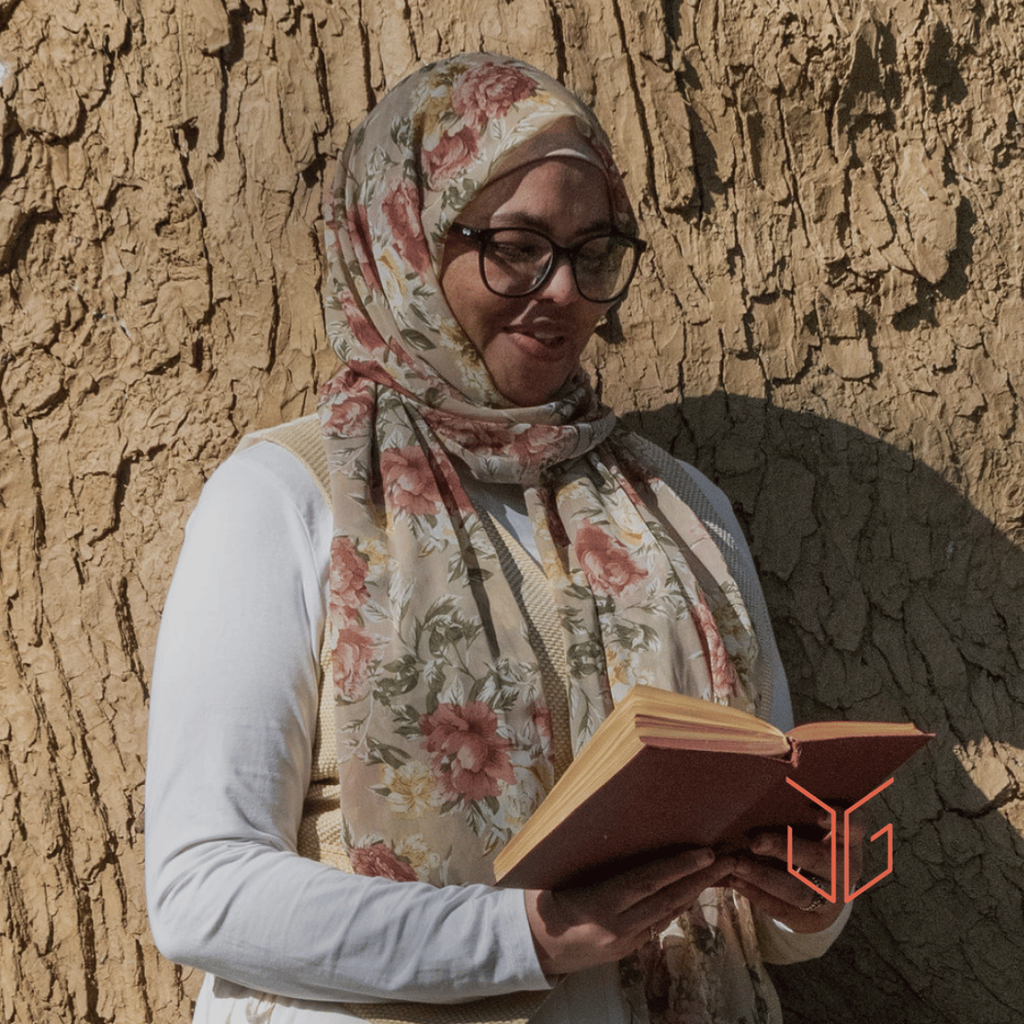
Rushdiyah Narker is pursuing a Masters in Social Anthropology at University of Cape Town. Her debut Novel Some Unspoken Thing was published in 2025 with Penguin Random House and she won the Science Fiction & Fantasy South Africa Nova short story in 2025.


