“Go laugh in the places you have cried” is always the thing that brings me to Boeka innie Bo-Kaap.
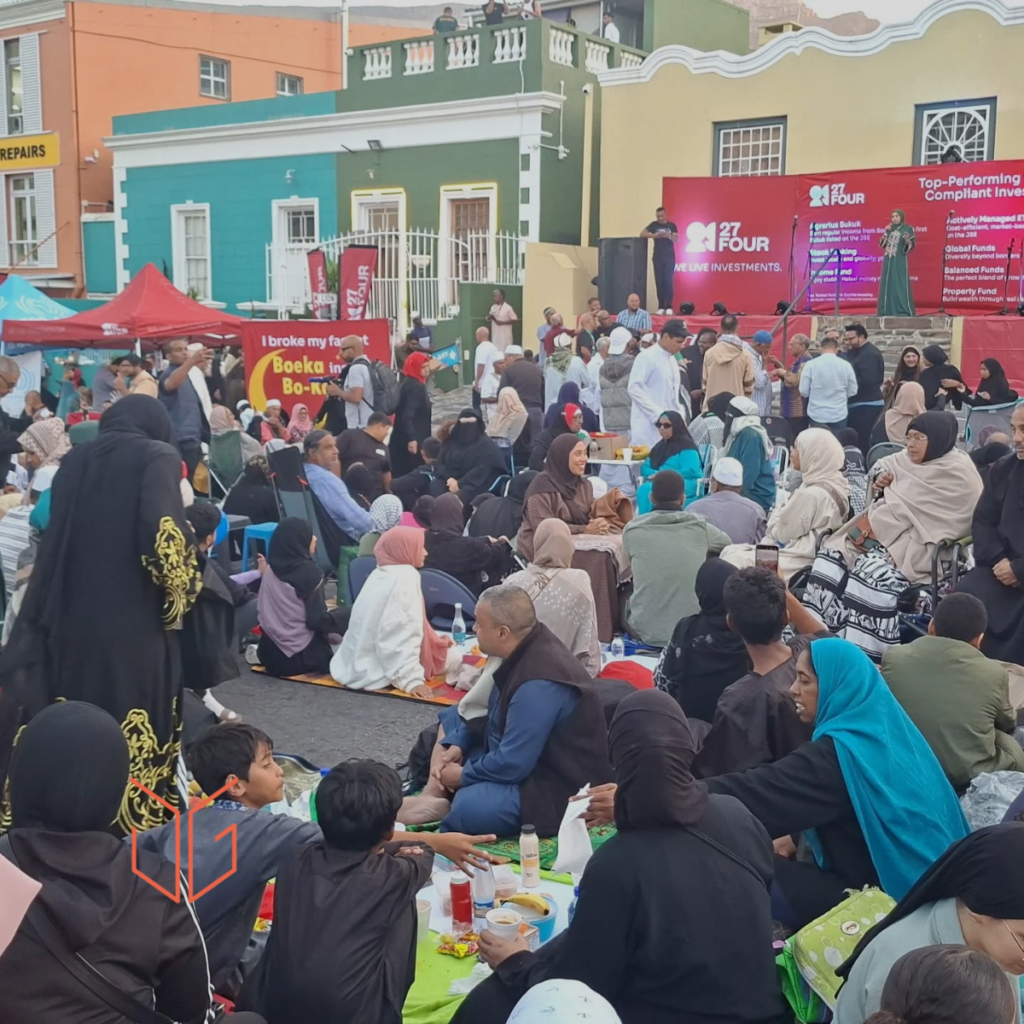

Muslims in Cape Town break their fast in Ramadaan at this event that takes place in Rose and Wales Street, Bo-Kaap. This year marks the ninth year this event has been held to protest gentrification and unfair urban development in the central business districts of Cape Town.
One such place is the Bo-Kaap, a suburb on the slopes of Signal Hill that, to date, houses residents of the Cape Malay Muslim community who first took up residence there in what was referred to as the Malay Quarter.
I don’t know, I can’t always explain it. But as the daughter of the Apartheid-surviving generation, the daughter of parents who both grew up in District Six, and a mother who was raised across all three, District Six, Bo-Kaap and Walmer Estate, I always feel the need to take Daddy by the hand and lead him there – even though he’s the one paying for our Uber!
It’s just about a year now since Mamma passed on 17 February. Ramadaan is ’n eina time for us because it’s a reminder that she’s gemaningal. Just days after we buried her last year, did the two of us sit at the same Boeka table for the first time without her, heartbroken, taking sips of water, a bite of dates and breaking pieces of daltjies into my bowl of soup (I’m Capetonian like that!) without her at the table, me sitting in her place, Daddy still sitting in his own place. We’re just about getting used to her not being here, but we still miss her.
I told Daddy, “Check your phone.” The Bo-Kaap Cultural Hub is taking orders for Eid for the red kufia, a cultural symbol of the Cape Muslim folks. Interested Boeta’s must pick their size and put in an order to have it custom-made. You can’t really buy these things anymore in Cape Town, so I told Daddy, “Bismillah, there’s your chance.”
Ten years ago, I visited Jakarta. Daddy asked me to buy him a red kufia. I was hanging out at the National Museum, and I saw a Boeta, one of the locals, wearing such a red kufia. I asked him where can I buy what he’s wearing on his head. In a split second, a woman standing next to him gave me a piece of paper that said “Tanah Abang”, a Chinatown market of some sort for all your traditional local garments in bulk at a fair price! Moments later, he ran after me (“Ibu! Ibu!”), took off the red kufia from his head and gave it to me. Oulyk, mashallah!
Only years later, when my cousin Thaakirah bought my dad that red kufia (“songkok merah” in Bahasa Indonesia) on a trip to Morocco, did I realise I was looking in the wrong place the whole time! Nonetheless, Daddy’s collection of black “skuitjie kufias is growing since I’ve now been to Indonesia twice (a kufiah that resembles a ship, which I’ve always wondered, is it the ship that brought the kufiah here in 1652? Oral history problems!)
That same weekend after Boeka innie Bo-Kaap, I was washing the dishes, and Daddy walked into the kitchen with the red kufiah Thaakirah bought him. He had a few minutes while waiting for the rain to stop before walking to Checkers. Daddy showed me the black tassel – “tossie”, he said, which Mamma used to call a “pom pom” that I tie my hair with – at the top of the kufiah. Only Boeta’s who have been on Hajj in Mecca are allowed to wear red kufiah’s with a tossie, he said, and if you wear a kufiah just like that in the street without having been on Hajj you are demeaning the kufiah! All these anecdotes, and still the kufiah order wasn’t put through yet to Bo-Kaap.
I kinda figured that if we made it to Boeka innie Bo-Kaap, then we could’ve made a turn at the Bo-Kaap Cultural Hub for him to try on any sample sizes available. It’s mos just up the road in Pentz Street, moments from where we were sitting in Wales Street. But the Hub was busy cooking large pots of food for their charity programs, and for another, we only arrived in Wales Street at 7 pm, 30 minutes before Boeka time. No time for kufia fittings.
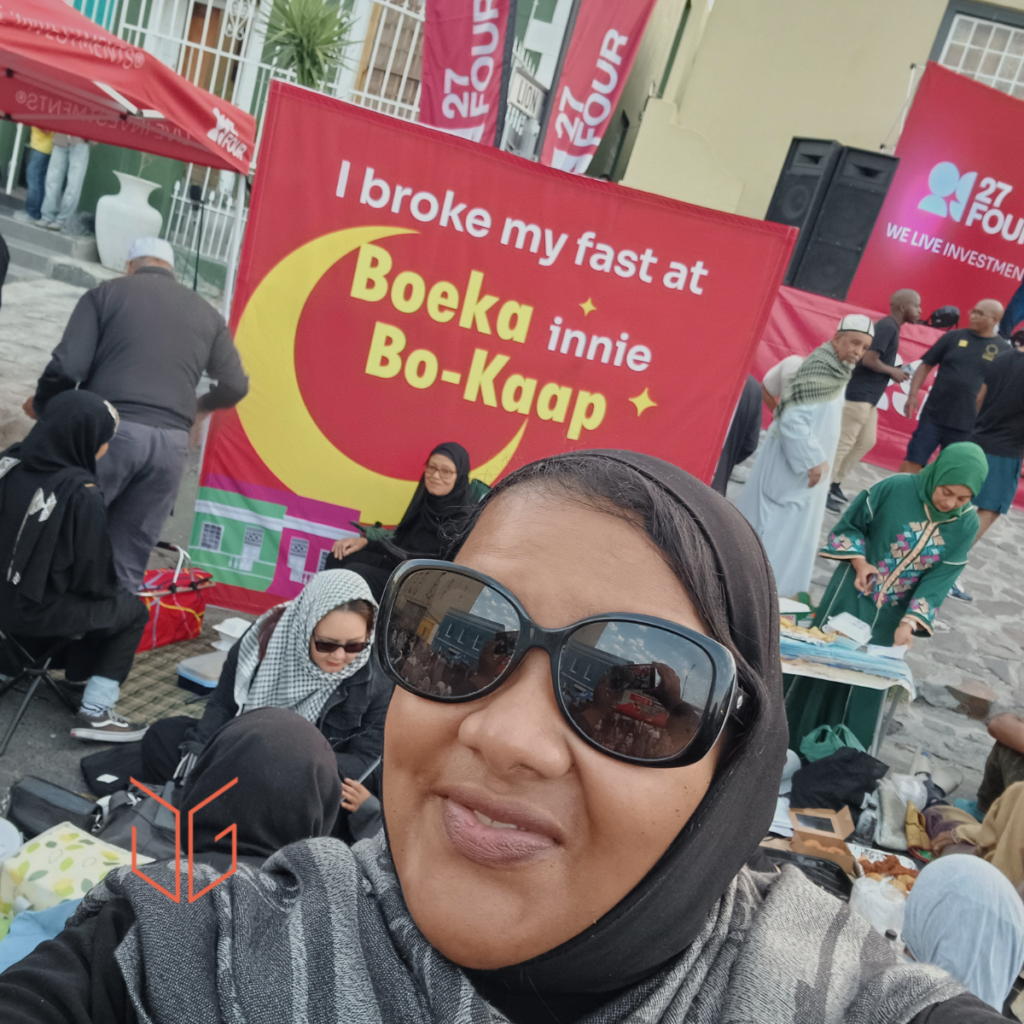
Shafwaan Laubscher, one of the hosts of Boeka innie Bo-Kaap, asked me, “Will we see you there?” and I texted back, “Yes, if you will let my Daddy borrow your camp chair to sit on!” Yinne, I got a text back later that night asking if I made it to the event because the camp chair was still in his boot, unused. Tamaaf, Shafwaan! Shukran and tramakassie for a leqqa night, and I took a selfie in front of the “I broke my fast at Boeka innie Bo-Kaap” banner. That’s what happens when you arrive half an hour before the time because you were waiting for your baby niece and nephew from Mitchell’s Plain to arrive so they can tag along, and then the multiple red robots we encountered in the Uber along the way. I told Shafwaan we found another chair, but it’s alright, let him ma remember to put the chair again in the boot so I don’t have to worry where will Daddy find a chair next time.
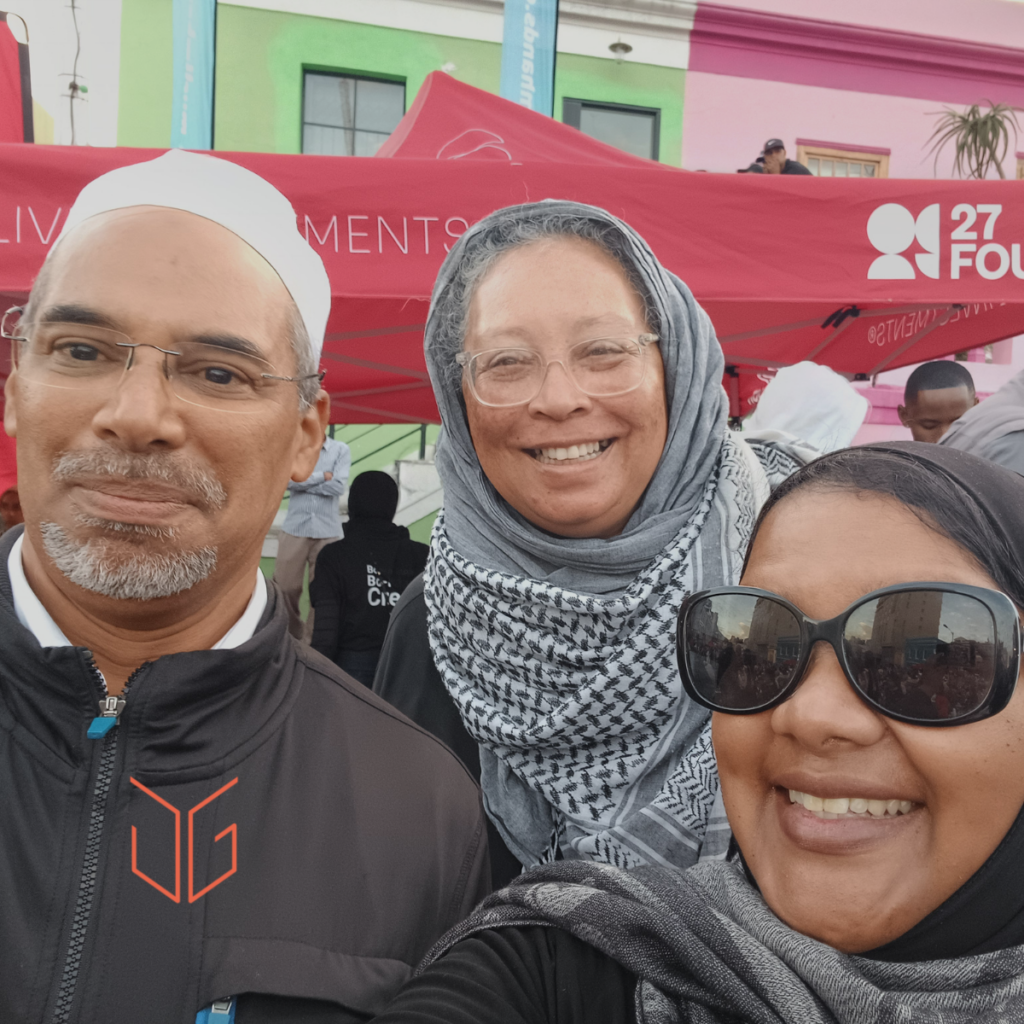
It’s always nice bumping into people you know at Boeka innie Bo-Kaap. I ran into my former Muslim Youth Movement (MYM) leader, Muhammad Groenewald, in front of the Bo-Kaap Museum just as the Imam was chanting “Free, free Palestine!” and “Free, free Bo-Kaap”. Because yes, these two movements share similar messaging, and Cape Muslims never fail to remind others that there are Palestinian Muslims who can’t peacefully enjoy the freedom of association and public expression of Islam like we can in South Africa, right here, right now at Boeka time. Boeta Muhammad lifted his “amandla” fist in the air as I took a group selfie with the two of us.
A very nice family sat next to us and shared their milktart with us since we forgot ours at home – they told us it’s uitgesit that we sat next to each other that night. A banana loaf and a box of sausage rolls were passed around by someone I don’t know. Still, even though I grew up in this community, it still brings me to tears how generous our people are without even thinking about it. Daddy spilt the flask of boeber on his silky black salaah top, and another family next to me gave some paper towel to wipe it off, a family who happened to be the ones we hiked the mountains with when I was small, and we had the opportunity to say hello.
I remember a sinking feeling I had last year at this event, missing Mamma so badly, hoping and praying that the people who walked past us would be people she knew so that I have the feeling of seeing and speaking to Mamma that night. Mamma partly spent her childhood with her grandmother in Bo-Kaap, a strong matriarch by the name of Khadija Dalwie, who used to do washing and ironing for white women, the “missies”. It helps to be at an event like Boeka innie Bo-Kaap when you’re feeling like that. A place of connection, the only place in Cape Town that feels exactly like our ancestral Indonesia. The Mass Street Boeka medium has, since 2018, spread to the rest of Cape Town, and now other areas like Bonteheuwel, Manenberg and Hanover Park host similar events in Ramadaan to claim space against gangsterism, crime and other invasions of peace and security. Alhamdulilah!
Although, of course, the millennial in me had to use her voice and remind others the next day to be mindful of AI-generated advertising when spreading the word about the Mass Boeka’s. Lots of (what I’m assuming to be) Chat GPT-generated posters are circulating on the socials and even on restaurant windows. I sent out a broadcast to remind our people that our ancestors from Indonesia, who were forcefully brought here in 1652, were artisans who made things by hand. Are we representing our culture appropriately in public when we ignore the human-generated creative skills of our local graphic designers, illustrators and visual artists, and we give the prerogative to AI to represent our culture instead of them?

Tasneem Daniels has a 10-year combined portfolio in media, education, arts and entertainment. Tasneem formed part of the first group of playwrights to take up residence at the Jakes Gerwel Foundation (JGF) Paulet House. Here she wrote Miela’s Box, a show collaboratively produced with the JGF in 2020 that debuted on stage and radio stations nationally. Tasneem’s play lead to a career in TV and radio programming with Suidooster (kykNET), An Nur – The Light (SABC 3), Radio 786 (100.4 FM) and the University of the Western Cape (UWC) in collaboration with Bush Radio (89.5 FM). Miela’s Box made a comeback on internet radio in 2024 with Cape Flats Radio and Radio Eersteriver. Tasneem also writes for LitNet, and she is writing her first musical after completing the How to Make a Musical Masterclass in 2019 with David Kramer at the Baxter Theatre. Her interests include tracing her Cape Malay / Indonesian roots and using her travel pursuits to develop her creative businesses.


One thought on “The Heroine’s Journey – The One About Boeka innie Bo-Kaap 2026”
One of the best events I’ve attended. It was spiritually and emotionally. I love the crowd and set up